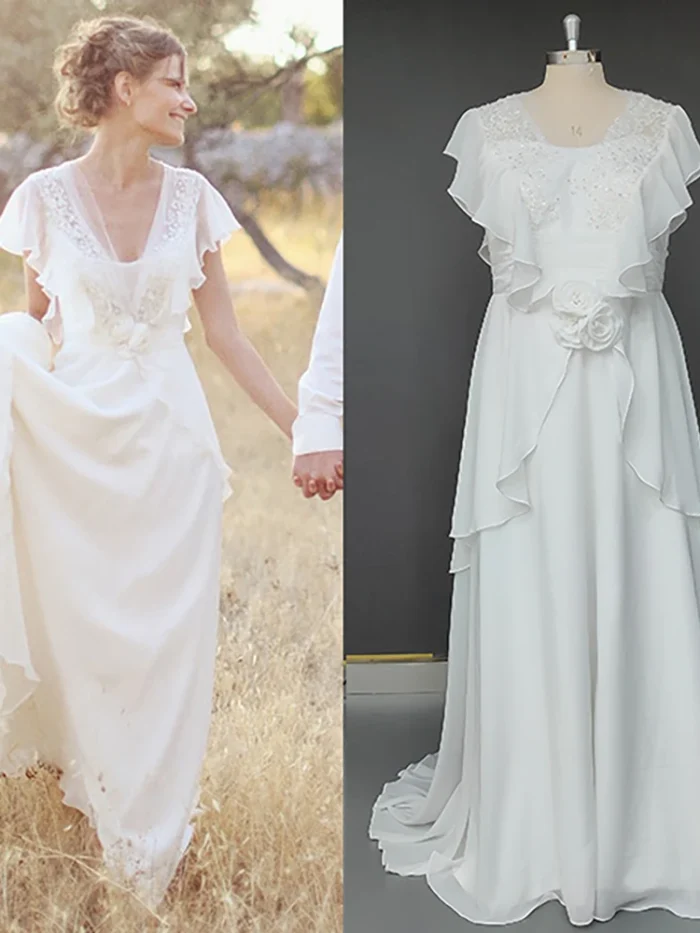
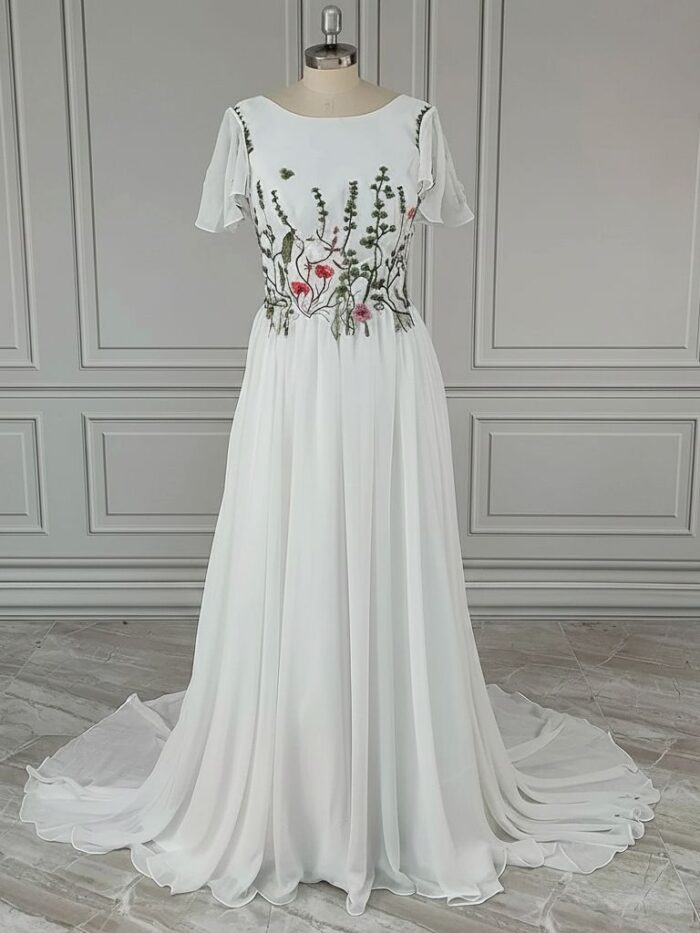
A floral wedding dress can be almost invisible or completely the point. White embroidery on white tulle reads as texture from a distance. A scatter of coloured thread or lifted 3D petals reads as colour from across the room.
Start with how much you want the flowers to speak, then choose the lace, the colour and the shape.
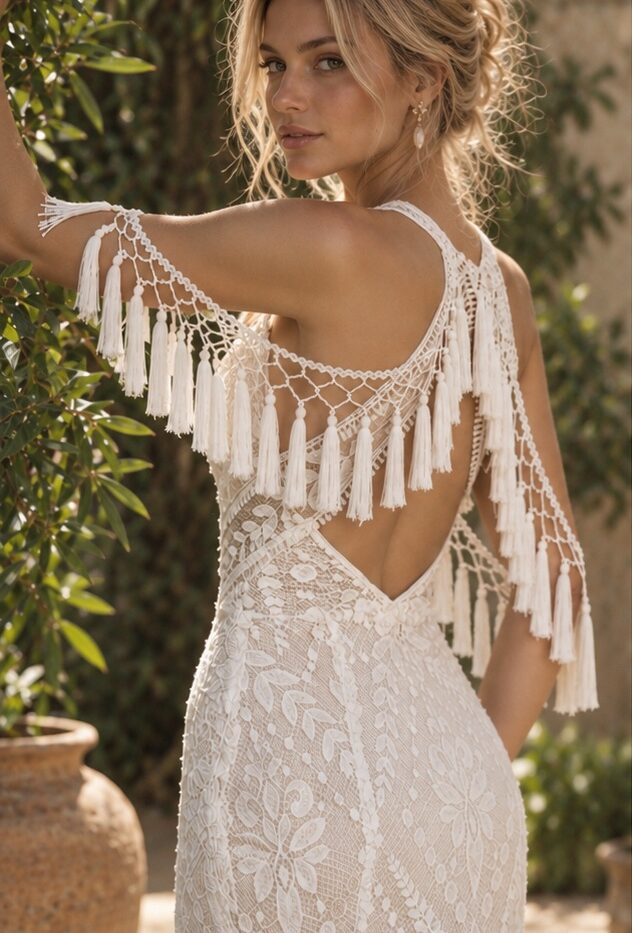
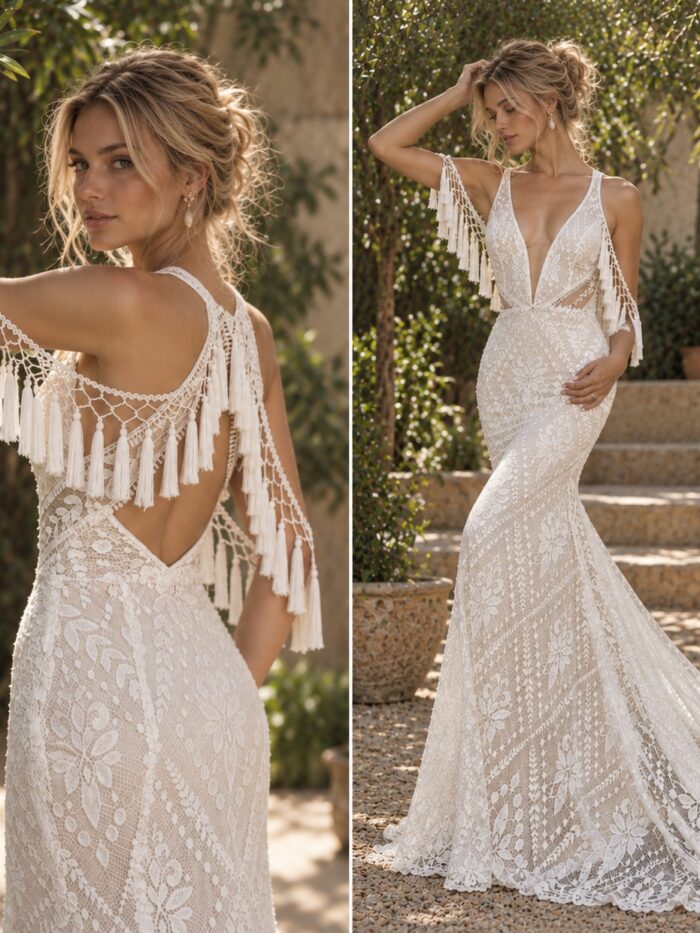
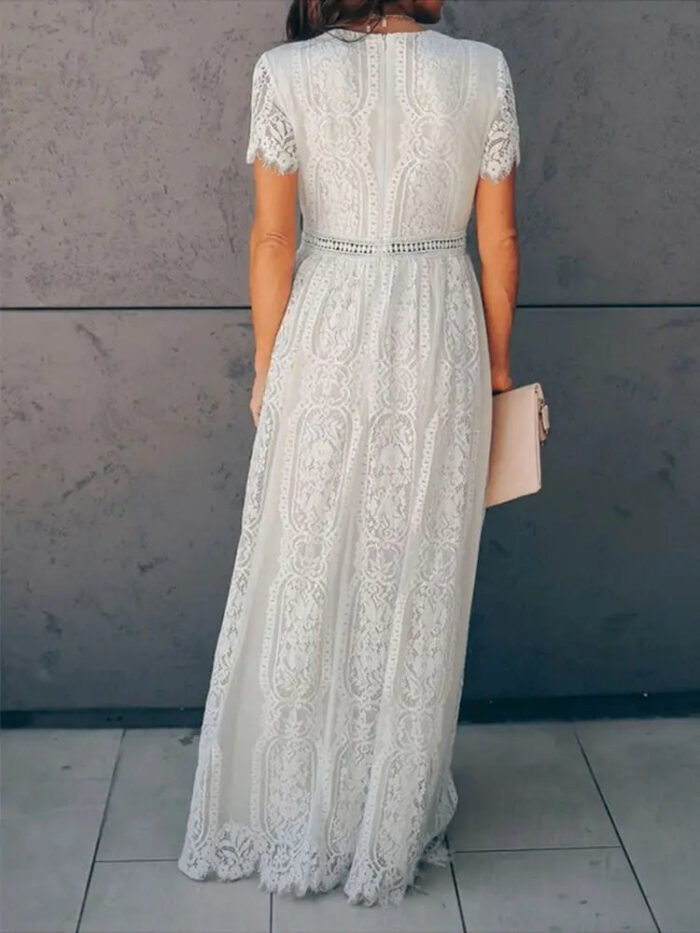
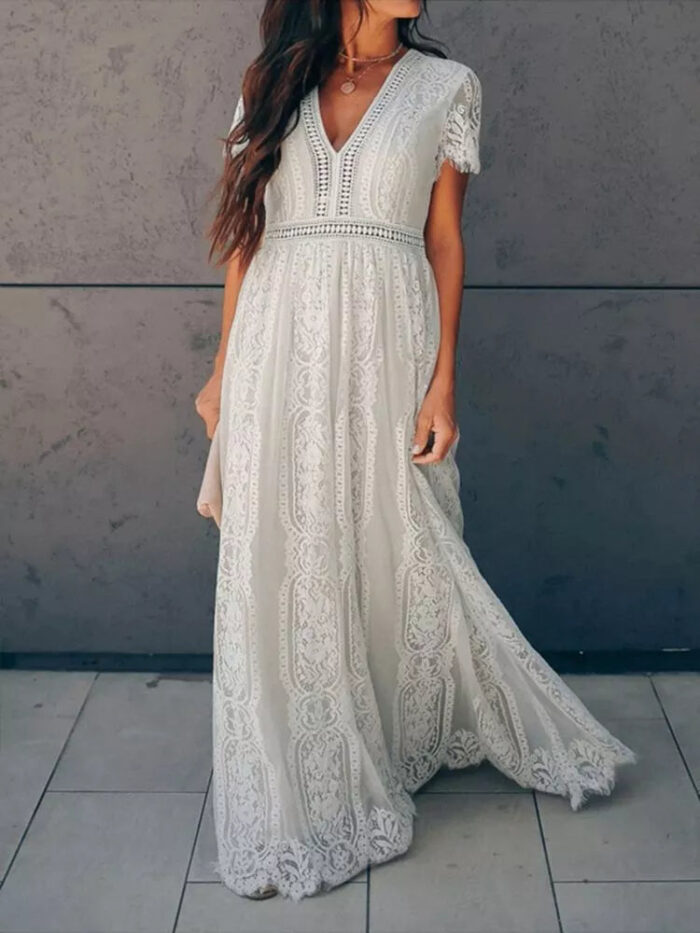
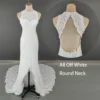
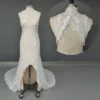
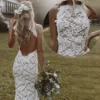
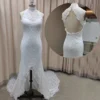
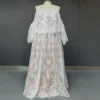
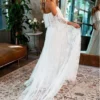
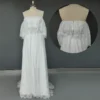
Browse the collection below.
How to choose a floral wedding dress
Floral wedding dresses cover a very wide range. Two gowns can both be described as floral and look nothing alike: one a whisper of white embroidery, the other a printed garden in full colour. The useful first question is not which flowers you like. It is how loudly you want them to speak.
Once that is settled, everything else gets easier. The lace, the colour, the silhouette and the styling all follow from that one decision.
The quick answer
If you want subtle: look for white or ivory embroidery on the same colour base. The flowers read as texture in photographs and as detail up close.
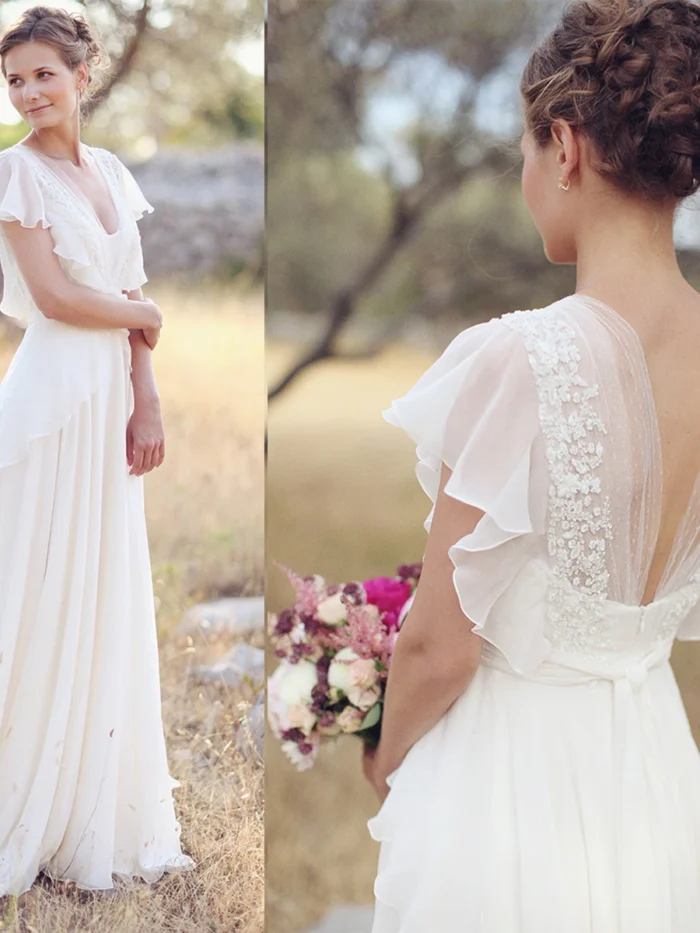
If you want noticeable but still bridal: choose floral lace with open ground, or tonal embroidery a shade or two away from the fabric.
If you want colour: coloured thread, a printed floral or three-dimensional applied flowers. Keep the rest of the styling quiet so the dress stays the main event.
For every version: check the floral detail at a distance as well as close up. Many patterns that look beautiful in a product photograph disappear entirely from two metres away.
The four kinds of floral, and what each one does
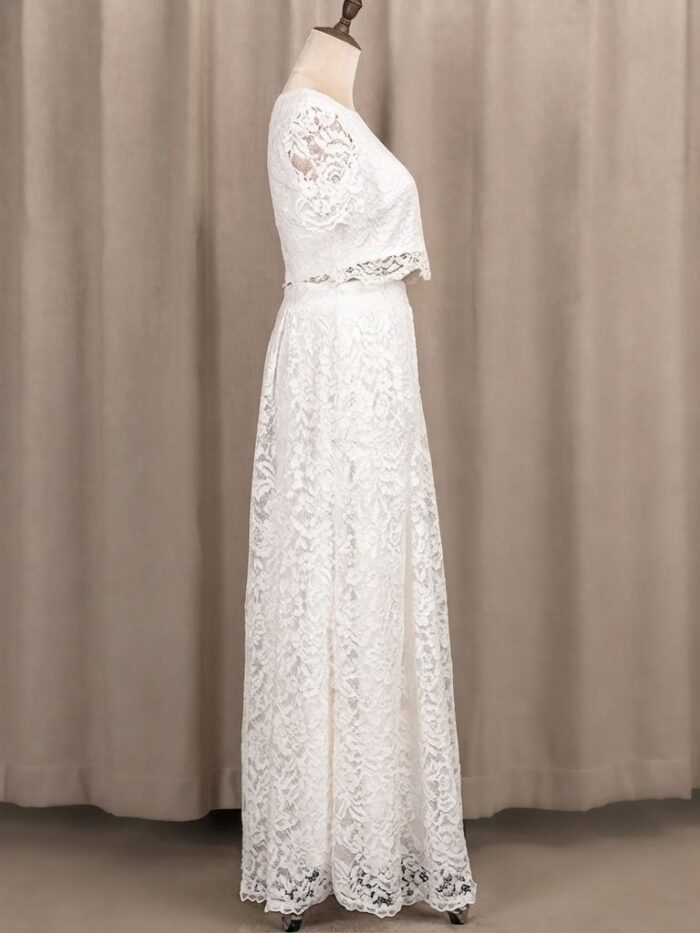
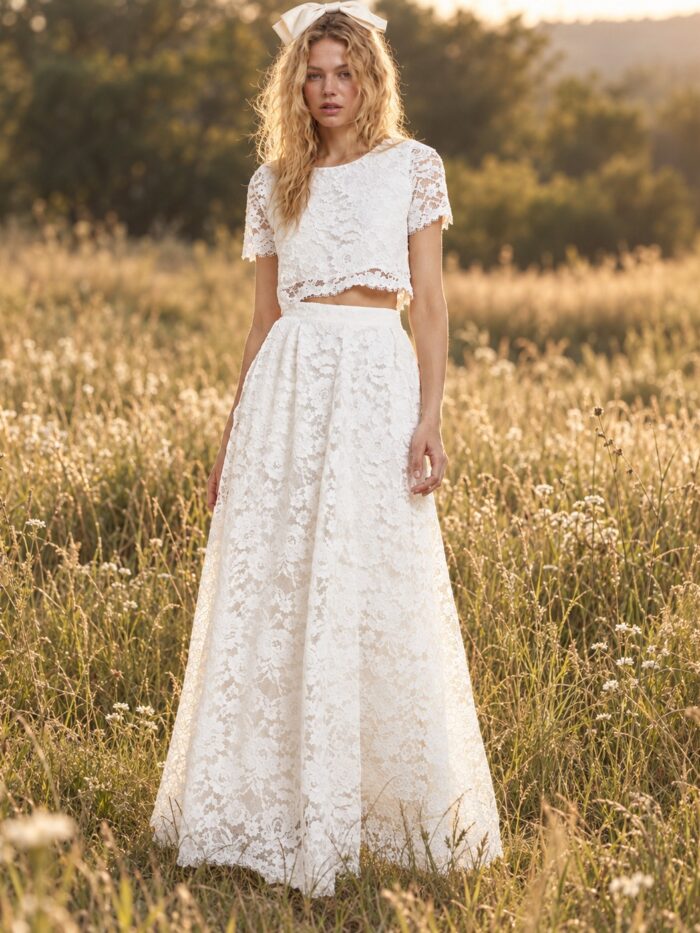
Floral lace. The most common and the most forgiving. The flowers are part of the lace itself, usually in the same colour as the gown. Corded floral lace holds its shape and reads clearly. Open floral lace with a lot of gap between motifs reads softer and lighter.
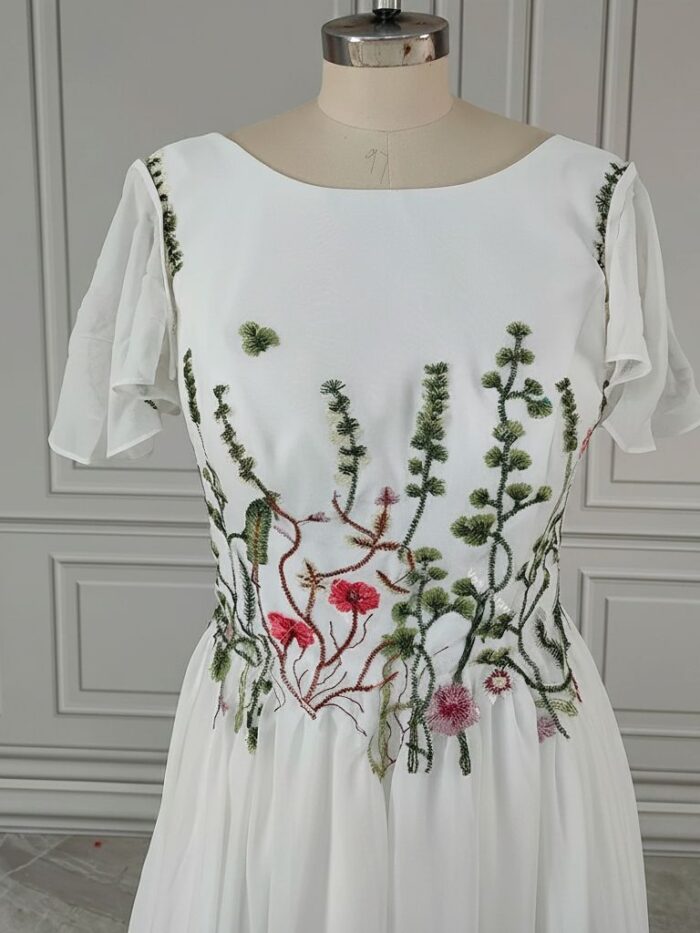
Embroidery. Flowers stitched onto the base fabric, often tulle or organza. Embroidery gives you control over placement, so it can be scattered across a skirt, concentrated at a hem or run in a band at the bodice. Tonal embroidery is quiet. Coloured embroidery is not.
Print. The pattern is printed on the fabric rather than built into it. Print gives the strongest colour for the lowest weight, which suits warm weather and travel. It is the least traditional of the four and the most likely to date, so choose a pattern you would wear again.
Applied or three-dimensional flowers. Separate fabric flowers attached to the gown. These photograph beautifully and create real shadow and depth. They also add bulk, so check how they sit when you are seated and whether anything catches.
Match the flowers to the venue
A floral gown has to share the frame with whatever is already around you. In a garden, a meadow or a vineyard there are flowers everywhere, so a loud printed floral can compete rather than stand out. Tonal embroidery usually wins in those settings, because it keeps the detail on you.
Indoors the opposite is true. A stone chapel, a barn interior, a candlelit dining room or a city venue gives you a plain backdrop, and a coloured floral has room to be the brightest thing in the photograph.
On a beach or in a desert, think about light rather than background. Strong midday sun flattens tonal embroidery almost completely, so if your ceremony is at noon and you want the flowers to show, you need contrast rather than texture.
Colour, and how far from white to go
White on white is the safest route and still the most popular. The gown reads as a classic bridal dress and the flowers appear as you get closer. Ivory on ivory does the same with a softer, slightly older feel.
One step further is tonal: champagne thread on ivory, or ivory on white. The flowers are visible across a room but the gown still reads unmistakably bridal in every photograph.
Full colour is a real decision rather than a detail. Coloured florals look wonderful and they will be the thing people remember, which is exactly right for some weddings and wrong for others. If you are unsure, consider keeping colour to one area, such as a hem or a single band at the waist, rather than across the whole gown.
Floral by season
Spring. Light floral lace and fine embroidery suit the season and the light. Avoid anything heavy underneath if your ceremony is outdoors and the ground may still be damp.
Summer. Print and open floral lace are the most comfortable. Look for unlined sections and breathable base fabrics rather than dense corded lace.
Autumn. The richest season for floral. Deeper tonal embroidery, champagne thread and three-dimensional flowers all suit autumn light, and sleeves become practical again.
Winter. Texture over colour. Heavier floral lace, layered embroidery and applied flowers all hold up in low indoor light, where a fine tonal pattern can vanish.
What to wear with a floral wedding dress
Keep the jewellery simple. A gown that already carries a pattern does not need a patterned necklace competing at the neckline. Plain metal, pearls or nothing at all is usually the better answer.
Think carefully about the veil. A floral gown under a floral lace veil gives you two patterns at different scales, and in photographs they rarely agree. Plain tulle over a floral gown is the reliable choice. Our wedding veils collection has both, so compare them against your gown rather than on their own.
For the bouquet, decide whether you want it to match the dress or contrast with it. Matching reads coordinated and calm. Contrasting reads livelier. What does not usually work is almost matching, where the two sets of flowers are close enough to look like a mistake.
Fit, sizing and ordering
Measure before you order. Take fresh bust, waist and hip measurements and compare them with the size chart on the individual product page rather than relying on your usual dress size.
Floral gowns add one extra thing to check: where the pattern sits on your body. A large motif placed across the bust or hip behaves differently on different heights, so look at the product photographs for placement, not only for the pattern itself.
Allow time for alterations either way. A hem change on a floral gown needs more care than on a plain one, because the pattern has to still make sense after the cut.
Floral wedding dress questions
Is a floral wedding dress still traditional enough?
White or ivory floral lace has been part of traditional bridal dressmaking for well over a century, so a tonal floral gown reads as entirely classic. It is coloured floral, particularly printed colour, that moves away from tradition. If that matters at your wedding, stay tonal.
Will the flowers show up in photographs?
Tonal embroidery and white floral lace show clearly in soft or indoor light and much less in bright midday sun. Coloured and three-dimensional florals show in any light. If your ceremony is outdoors at the brightest part of the day and the pattern matters to you, choose contrast over texture.
Can I wear a coloured floral dress as a bride?
Yes, and more brides do each year. The practical advice is to keep one thing clearly bridal, whether that is the silhouette, a veil or the length, so the look still reads as a wedding dress rather than an occasion dress.
What is the difference between floral lace and embroidery?
In floral lace the flowers are part of the fabric's own structure. In embroidery they are stitched onto a base fabric afterwards. Lace tends to look more uniform across the gown. Embroidery can be placed exactly where it is wanted, so it is often used for scattered or graduated designs.
How do I stop the dress and the bouquet clashing?
Either match them deliberately or contrast them clearly. Pick two or three colours from the gown and repeat them in the bouquet, or choose a bouquet in a completely different palette. The combination to avoid is one that is nearly the same.
Do floral wedding dresses work for a second wedding or an elopement?
They suit both particularly well. A floral gown feels personal rather than ceremonial, and the shorter and lighter styles travel easily and photograph well outdoors without needing a large setting around them.
Finding your floral wedding dress
Decide how loud you want the flowers to be, then look at the venue and the light you will actually be standing in. Those two answers will remove most of the collection for you, which is the point.
After that, judge each gown twice: once close up in the detail photographs, and once at the smallest size you can view it, which is roughly what a guest will see. The gowns that still work at both distances are the ones to try.
To provide the best experiences, we use technologies like cookies to store and/or access device information. Consenting to these technologies will allow us to process data such as browsing behavior or unique IDs on this site. Not consenting or withdrawing consent, may adversely affect certain features and functions.
Functional
Always active
The technical storage or access is strictly necessary for the legitimate purpose of enabling the use of a specific service explicitly requested by the subscriber or user, or for the sole purpose of carrying out the transmission of a communication over an electronic communications network.
Preferences
The technical storage or access is necessary for the legitimate purpose of storing preferences that are not requested by the subscriber or user.
Statistics
The technical storage or access that is used exclusively for statistical purposes.The technical storage or access that is used exclusively for anonymous statistical purposes. Without a subpoena, voluntary compliance on the part of your Internet Service Provider, or additional records from a third party, information stored or retrieved for this purpose alone cannot usually be used to identify you.
Marketing
The technical storage or access is required to create user profiles to send advertising, or to track the user on a website or across several websites for similar marketing purposes.












 +8







 +4





 +3


